Capturing the Wisdom of Coastal Communities to Inform the City’s Open Space Planning Process
In November and December of 2025, L.A.’s City Planning department was working on updating the Open Space Element of their General Plan for the city. The Open Space Element was adopted in 1973, and guides preservation of open space in L.A. “to serve the recreational, environmental, health, and safety needs of the City.” L.A. City Planning hired the nonprofit organization Heal the Bay to conduct two workshops with coastal community-based organizations—Verdant Venice and Resilient Palisades. In the workshops, Heal the Bay used the Living Infrastructure Field Kit to collect coastal community wisdom to inform the Open Space Element planning process.
Who
Heal the Bay is an environmental nonprofit organization that uses science, education, community action, and advocacy to make the coastal waters and watersheds in Greater Los Angeles safe, healthy, and clean. Heal the Bay conducted the workshops.
Verdant Venice is a grassroots community organization dedicated to increasing the native tree canopy and greening the understory throughout the Venice community. Verdant Venice members were the participants of one of the workshops.
Resilient Palisades is a nonprofit organization focused on practical and local solutions across wildfire recovery, home electrification, zero waste practices, native habitat restoration, invasive plant removal, sustainable food systems, community education, and climate policy. Resilient Palisades team members were the participants of the other workshop.
L.A. City Planning is the government body that oversees planning and development in L.A. It also manages updates to zoning, discretionary project applications, and historic preservation efforts. It is currently updating the Open Space Element of their General Plan for the city.
Objectives
- Ensuring that L.A. has “equitable distribution of, access to, and meaningful connections between sufficient and well managed open spaces, while balancing sustainable growth and development.” —Open Space Element of the General Plan, LA City Planning
- Collect comments from coastal community-based groups in order to enrich the ongoing planning process for the Open Space Element with place-sourced knowledge and wisdom.
Process
Formulate Questions: L.A. City Planning divided its larger goals for the Open Space Element into six specific goals, listed below. For each goal, they wrote questions to present in the workshops to the community organizations. Each goal below has one sample question below it, though some goals had up to six questions. They gave these goals and questions to Heal the Bay, who used them to conduct the workshops.
- Open space that is composed of adequate and equitably distributed land and water
- Are there open spaces in your community that you feel need stronger protection or conservation?
- Open space with coordinated and inclusive planning, management, and stewardship
- What partnerships would you like to see to help manage and maintain open space in your neighborhood?
- Open space that provides equitable access to safe, high-quality environments, facilities and programs that serve diverse needs
- What barriers prevent you or others from accessing open spaces in your area (e.g., transportation, public safety, physical accessibility, etc.)?
- Open space that strengthens climate resilience and provides ecosystem benefits
- How can public open space in your community serve as a resource during climate emergencies (e.g. extreme heat, flooding, wildfire, etc.)?
- Open space that supports healthy ecosystems and healthy people
- What types of ecosystems and environments (e.g. water, forests, meadows, etc.) would you like to have more access to?
- Open space that preserves historic resources and supports cultural practices
- What factors should be considered to identify open spaces of scenic, historic, or cultural value and how should they be preserved?
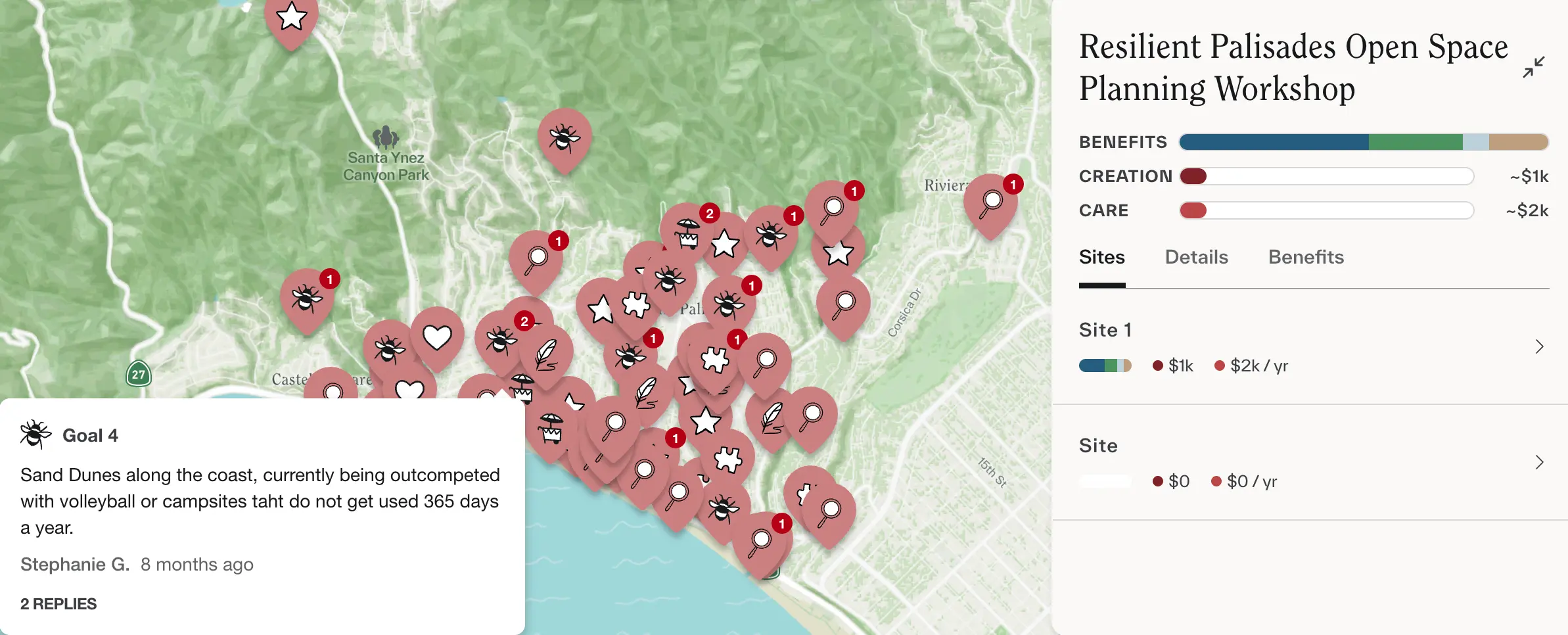
The Resilient Palisades Workshop: This workshop was hosted virtually with 10 members of the group in attendance. The host from Heal the Bay, Stephanie Gebhardt Rath, opened the Field Kit in screen share on the video call, but also shared the project so that participants could participate by adding to the map directly. Gebhardt Rath used the observations tool to record verbal comments during the meeting, and participants also typed in their own. Observation threads were named for the goals, one through six.
“We annotated the notes, using the Field Kit, allowing them to also put their own notes into the field kit using the observations tool.” —Stephanie Gebhardt Rath, Heal the Bay
During the workshop, the host also used the Field Kit’s data layers to help the group answer questions like:
- Are there open spaces in your community that you feel need stronger protection or conservation?
- Where would you like to see more open space created or expanded?
- Which neighborhoods or areas do you think should be prioritized for new open space investments?
- Are there specific climate impacts and challenges in your area that open space could help address?
The Field Kit itself at some point became a topic of conversation, when the host suggested it for future use to address community concerns.
“They were really concerned about artificial turf going in, and so I demonstrated how, for instance, the Palisades High School could become a site and some of the other elements of the Field Kit. I showed them how much it would cost… I did show them the abilities to select a site and add remedies and they were jazzed by that.” —Stephanie Gebhardt Rath, Heal the Bay

The Verdant Venice Workshop: This workshop happened in person at the Venice Skills Center with about 15 people. A large map of the area was printed out and set up in the space. Remedy icons from the Field Kit were printed out and participants physically placed them on the map in response to the workshop questions. The host from Heal the Bay recorded participants’ verbal comments and answers to questions into the Field Kit as the workshop progressed. Gebhardt Rath also used a projector to show the group the Cal Enviroscreen and tree canopy data layers to help them answer questions.

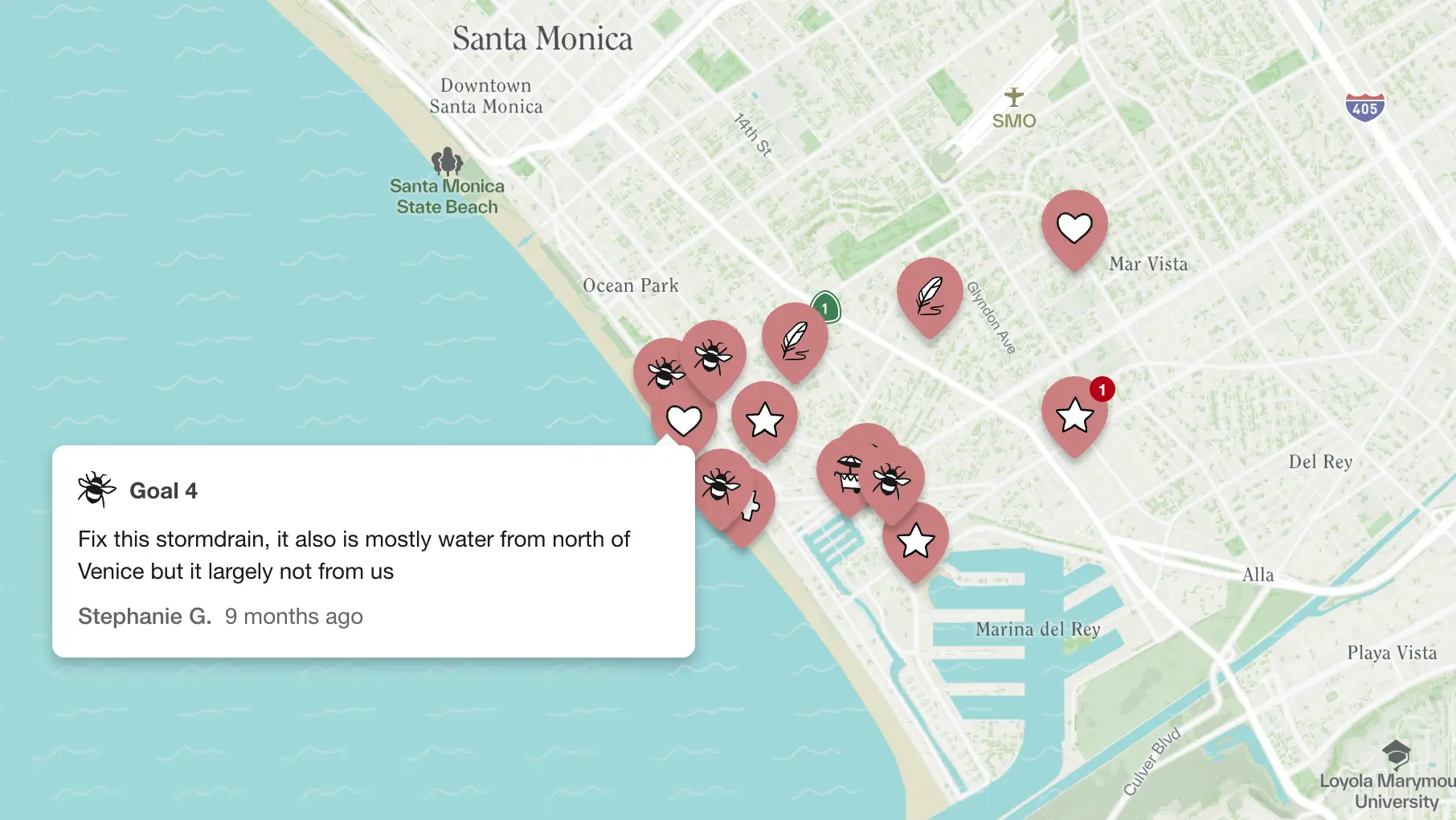
Passing Along the Data: Heal the Bay turned in the answers to the questions, comments, and the Field Kit map links to L.A. City Planning, to be incorporated into ongoing planning work.

Takeaways
- The Field Kit’s data layers provide communities with data that complements their knowledge and lived experiences, allowing for rich conversations in participatory processes.
- The Field Kit’s collaborative project-sharing functions and their flexibility allow for multiple modes of participation on the same map simultaneously. People can access the shared map directly and input comments while a host captures what is contributed verbally.
- The Field Kit lends itself to hosting both in-person and virtual workshops comfortably, and can adapt to support either mode of participation.
Artifacts
Sources